Monday, July 28, 2014

Hadrian’s Arch and the Temple of Zeus

June 2nd, 2014

After touring the Agora, we happened upon a lovely little square with outdoor dining, just in time for a much needed lunch stop! We ordered the Gyros, and were surprised that they were served on a plate, not in a pocket pita.But they were delicious! and, after a hearty lunch, we were on our way.

We were touring Athens on our own (with the help of Rick Steves travel guide and audio tours) and on our feet. We walked down a number of shopping streets, but we were headed back in the direction of our hotel, and the Temple of Zeus. At the end of the street, just in front of the Temple of Zeus, was Hadrian’s Arch.

IMG_4595

This Arch was built by the Roman Emperor Hadrian in the 2nd century AD. Hadrian wanted to properly mark the end of the ‘Greek’ section of town, and announce the start of this ‘new’ Roman subdivision. It was kind of neat, but not overly impressive, but it does give insight into the tensions that come with conquering and occupying a nation.

The Temple of Zeus, just behind the Arch, is currently  surrounded by a grassy, park-like area, that, though hot and sunny, provided a nice setting to enjoy sitting and soaking up the sense of ‘antiquity’ while resting a bit.

IMG_4477

The building of the Temple of Zeus was started in the 6th century BC, but was not completed until Hadrian took over 7 centuries later.

IMG_4578

15 of the original 104 Corinthian columns still stand, leaving the reconstruction of the Temple to our imaginations.

IMG_4587

I think that I was most impressed by the sheer size of these columns…….

IMG_4584

And the decorative details……

IMG_4583

Note – This is a ‘Corinthian’ style capital (or top for the column) with the leafy decorations. The workmanship that went into these buildings is just amazing!

IMG_4593

This fallen column shows the discs or ‘drums’ that make up the column. The construction of all of the columns in all of the ruins that we have seen is almost too much to comprehend!

Our touring had taken us back to The Athens Gate Hotel, which was just across the street from the Temple of Zeus.

IMG_4579

We stopped for a much needed rest and ‘cool down’ before we headed out again.

Sunday, July 27, 2014

Mars Hill and The Agora

June 2nd, 2014
At the foot of the Acropolis, was a rock out-cropping, known as Mars Hill (after Mars, a god in Greek Mythology). Pretty nondescript, but known as the place where the Apostle Paul once preached.
IMG_4506
After Rome conquered Athens in 86 BC, Mars Hill was used by the Athenians for matters of minor governance. In the first century AD, Paul seized this platform to speak to the citizens of Athens against their worship of false Gods. The Athenians were not very receptive, however, and Paul only won a handful of converts, before moving on to Corinth, where he was better received.
We are not Bible scholars, but this was fascinating to us…..
IMG_4504
So we climbed the steps up to the top of the hill, being very careful of our step on the very slippery stone which had been worn smooth by time.
IMG_4508
As we stood where Paul once stood, we could feel the presence of this great man…….

Next up, the Agora (or gathering place) – the real heart of ancient Athens. For 800 years, from its founding in the 6th century BC to it destruction by barbarians in 267 AD. the Agora was the center for socializing, commerce, even politics and minor sporting events.
We kept trying to put ourselves in the frame of reference of ancient Greece, picturing the people and the city of Athens as it was in its Golden age. It was here, at the Agora, the center of everyday life, that we could really get a 'feel' for ancient Athens.


IMG_4552

This is the great Panathenic Way, the wide road through the Agora that leads up to the Acropolis. It is quiet now, but this would have been a bustling thoroughfare. Ancient Athens probably had a population of 100,000, and this was the main intersection in town.
Anyone and everyone spent time here. It was here that the philosopher Socrates, and his student Plato wandered about, talking with and learning about people. (I don't know about you, but this just gives me 'chills').  And here that the Apostle Paul probably had his greatest influence. 

IMG_4537
The Agora developed over time from an open air marketplace, to a kind of shopping mall, with stores and offices. These ruins are what is left of the columns and supports that would have been where a Stoa, or enclosed shopping center, would have stood. This is where one might come to buy groceries, clothes, household goods or any of a number of other items.
IMG_4525IMG_4527
The Agora was also the center for politics. The broken column in the center of these ruins marks the Tholos. The Tholos was a rotunda shaped building with a conical roof, which held Athens city council, or ministers, who ran the day to day affairs of Athens. The Tholos housed the headquarters, offices and meeting hall for the ministers.  Many of the 50 ministers lived here, as well, as the law required that a third of the ministers be on the premises at all times.
Athens originated the first model of Democracy. It was a new idea at the time that issues that concerned the people should be voted on by the people. Thus, people were allowed a platform to speak, and voting took place on everything from electing leaders to setting the price of commodities. When a leader became too powerful in the peoples opinion, a vote was held by writing that person’s name on a broken shard of pottery – an ostrakon- and when that person garnered enough votes, he was banished, or ‘ostracized’.  I just find it amazing how much of our culture we owe to the Athenians.
IMG_4483
The Agora was also a center for minor religious observances. One might stop by a temple to make an offering to the gods.This Temple of Hephaistos is one of the best preserved and most typical of the temples of its time. Built in 450 BC, it is similar in design to the Parthenon, only much smaller and less elaborate.
IMG_4521
Like the Parthenon, this temple was decorated with marble friezes along its perimeter.
IMG_4518IMG_4524
These marbles are more intact, and depict different stories and myths.
IMG_4535
The Stoa of Attolos, is a good example of the kind of ‘shopping malls’ that dominated the Agora.
IMG_4539
Originally built in the 2nd century BC, this Stoa was reconstructed in the 1950’s. It is a typical 2 story Stoa constructed of Pentelic marble, with porticos and Doric and Ionic columns. The covered walkways of the Stoas provided protection from sun and rain for the shoppers and business people.
This Stoa has been turned into a museum. There were so many amazing artifacts that I could not possibly post pictures of them all!
IMG_4540IMG_4541
This marble carving was part of a monument base, celebrating a victory at the 4th century BC Panathenaic Games.
IMG_4543IMG_4544
This is a bronze shield dating back to  425 BC.
IMG_4555
Also on the grounds of the Agora is this little church, The Church of the Holy Apostles. It was built around 1,000 AD to commemorate St. Paul's teachings in the Agora.
IMG_4562
It has a typical Greek- cross floor plan with 4 equal arms topped by a dome. IMG_4556IMG_4561
This church contains a number of interesting Byzantine style frescos…..though faded, they are still very moving.
From the Agora, we walked on through the streets of Athens……..

Saturday, July 26, 2014

The Acropolis

June 2nd, 2014

Visiting the ruins at the Acropolis is on the ‘must see’ list for any visit to Athens. In preparation for this trip, we watched several DVD’s about the Parthenon and other buildings atop the Acropolis.

The Parthenon was a temple dedicated to the goddess Athena, whom the people of Athens considered their patron. It was constructed to replace an existing temple which was destroyed by the Persians in 480 BC and cost 469 silver talents (close to 1 billion dollars in modern currency) to build. Its construction began in 447 BC under the orders of Pericles to show the wealth and exuberance of Athenian power. It was completed in 438 BC. and is, perhaps, the most important surviving building of Classical Greece. It is certainly the most recognizable.

Having been forewarned of the crowds, we got an early start, leaving our hotel around 7:30 am, and walking to the Acropolis, arriving as it opened at 8 am. This strategy paid off, as we were able to see most of the sites without too much of a crowd.

On our way up the Acropolis, the first site that greeted us was an overlook for the Odeum (or theatre) of Herodes Atticus. The Odeum was built in 161 AD by Herodes Atticus.  It was originally a steep-sloped amphitheater with a three-story stone front wall and a wooden roof. It was used for music concerts with a capacity of 5,000. It lasted intact until it was destroyed and turned into a ruin in 267 AD.

IMG_4430_thumb[1]

The audience stands and the stage were restored in the 1950s. Since then it has been used for music and theatre performances. Because it is only open to the public for performances, we were unable to tour the ruins up close but they were maybe even more impressive from this view.

We followed the marble walkway up to the top of the Acropolis.

IMG_4435_thumb[1]

I had to stop and take a moment to just feel…… these very stones were the stones upon which such feet had trod!

After arriving at the top of the Acropolis, one still had to climb…..up these stairs through the Propylaea, or entry way.

IMG_4439_thumb

This structure was built by Pericles at the same time as the Parthenon (438 BC). Its function was to instill the proper awe and reverence in worshipers as they came to the Acropolis, as this was the main purpose or use of the Acropolis.

IMG_4440

Truly awe inspiring, even in ruin!

IMG_4501_thumbIMG_4503

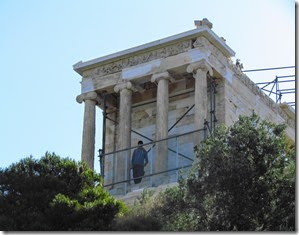
Just in front of the Propylaea, sits the temple to Athena Nike. Here, a statue of Athena holding Nike in her hand stood visible from below.

IMG_4445_thumb

The columns, made of marble, were HUGE! I really, really wanted to just reach out and touch such an ancient piece of history…….but there were ‘guards’ standing all around to remind you “Don’t touch”.

IMG_4443_thumb

These columns were constructed in segments of discs,  then stacked. An amazing feat of architecture.

IMG_4448_thumb

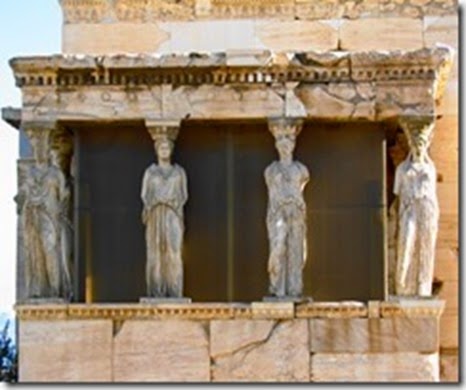
This building, the Erechtheion, was built about 420 BC, and was used as an additional temple in which Athena and Poseidon were worshipped.  On the right hand side of this photo is the ‘porch of the maidens’.
IMG_4453_thumb

There were 6 carved figures of maidens, or Caryatids……..once beautiful in their detail…..

IMG_4454_thumb

Now being eroded by the effects of pollution. As recently as 50 years ago, one could still see distinct facial features. These statures are faithful copies. Four of the original statues are undergoing laser cleaning and are on display at the New Acropolis museum.

By the way, though this beige and off white marble is what we think of as ‘classical Greek’, the truth is, the Greeks loved color. These statues, and the marble carvings that decorated the Parthenon, were all once painted with bright colors, now bleached by the effects of age and weather.

Behind this area, stood a 30 foot tall bronze statue of Athena Promachos (Athena depicted as the patron of battle) which was visible from the sea. This statue disappeared in ancient times.

IMG_4492_thumb

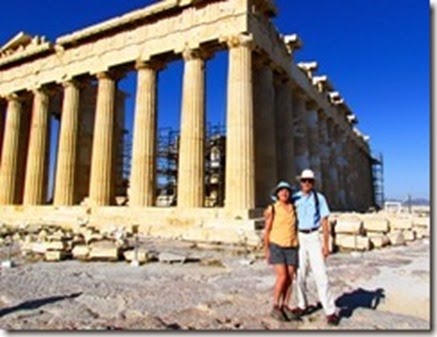
And finally, we made our way to the Parthenon.
IMG_4466_thumb

To appreciate the Parthenon, one has to use a bit of imagination. Picture this in the time of Pericles and Socrates….the Parthenon in all its glory on the day of the Panathaneic Parade. The parade passed through the Agora (marketplace), up the Acropolis, passed through the Propylaea, to arrive at the entrance of the Parthenon. People dressed in their finery, gathered on the surrounding grass (now just bare stone), musicians played, girls danced and horsemen reigned in their restless animals. On open-air altars, priests offered as many as 100 oxen as sacrifice to the Goddess Athena.

IMG_4447

Inside the Parthenon, the select few who were chosen to go inside would be greeted by a 40 foot statue of Athena, dressed as a warrior, with a helmet and a shield at her side. In one hand Athena held a spear, in the other was a statuette of Nike. Athena literally held victory in her hand. (This statue was carried off to Constantinople, where it disappeared. A small scale Roman copy of this statue is on display at the National Archeological museum.)

IMG_4457_thumb

The Parthenon, and the other Acropolis buildings were constructed from the finest Pentelic marble, mined in the mountains 16 miles away. Each column was constructed of ‘drums’ or ‘discs’ which were most likely cut at the quarry and rolled to the Acropolis, then hoisted in place by cranes. It should be noted that the work of building the Acropolis structures was done by free men who received a salary, not slaves.

IMG_4459_thumb

The columns were in the ‘Doric’ style (We learned the difference between Doric style and Corinthian style) lightly fluted with a simple scroll capital (or top). Interestingly, the columns were designed to tilt inward just a bit to provide a balance due to optical illusion.

IMG_4476_thumb

The Parthenon once had a tiled roof supported by cross beams. It was highly decorated with marble carvings. All along the interior ‘porch’ of the Parthenon, just above the inner columns, was a magnificent carving or ‘frieze, originally a 525 foot long series of panels that encircled the entire building. This frieze depicted the Panathenic Parade – dancing girls, men on horseback, animals being led to the slaughter. All of these carvings were painted in bright colors with a beautiful blue background.

Today, most of the original marbles are in museums. In the early1800’s, Lord Elgin removed most of the carvings ‘for preservation’ and took them to London, where they remain on display.  There is quite a dispute going on over this. Athens has constructed the new Acropolis Museum with display space for these marbles, and really wants them back. Though, they concede that it will probably not happen. The few originals that Athens does have are on display, and the others are represented with plaster replicas (and VERY pointed signs noting where the missing marbles are).

IMG_4461_thumbIMG_4468_thumb

The end panels depicted the birth of Athena, and Athena’s triumph over Poseidon. These few carvings are what is left at the site.

IMG_4474IMG_4472

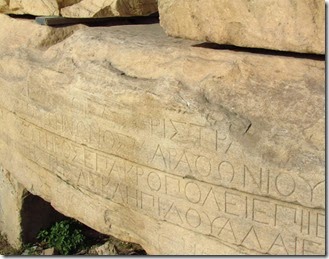
This stone, with its writing, just fascinated me. I don’t remember what its purpose was, but I loved that you could still see the writing from such an age ago.

Lastly, we overlooked the Theatre of Dionysus, which hosted great productions during Greece's ‘Golden Era’.  Athens was the birthplace of theatre- ‘Greek tragedy, comedies, music, etc..

IMG_4485_thumb

You could just picture the Athenians going to the theatre, perhaps including the works of Sophocles……

And then, finished with the tour of the Acropolis, we were headed out……..

IMG_4502

With one last glance backwards…….


Note- for some of my descriptions, I relied heavily on Rick Steves’ travel guides, so as not to have to trust my memory.

Wednesday, July 23, 2014

One For the ‘Bucket List’ - Our trip to Greece and Turkey

May 31 – June 18th, 2014 

First off, let me say that I know that it has been a long time since I have posted a blog. It is not that life has been too boring to post, but rather, that I have been taking the time to just enjoy the adventure, rather than worrying about recording it. That being said, THIS adventure really requires blogging……so here I go!

Few of our trips could really be called ‘bucket list’ trips. You know, the feeling that you absolutely MUST go somewhere, or do something, before you ‘kick the bucket’. This trip, however, really fit that description.

I have always been fascinated by Greece, and Athens in particular, as the birthplace of Democracy, Philosophy, and Western Civilization, Athens is old, incredibly old, dating back to 5,000 years BC. And who could not love a country that gave us Plato and Socrates, the Olympics, and the Spartans, as well as “Jason and the Argonauts”, and “Troy” and was the setting for “Mamma Mia”……..not to mention those beautiful blue and white houses of Santorini, and Greek Salad?

So, ‘one day’ morphed into ‘Why not now?’ and we set about making our plans.With a lot of research and some recommendations from Fred’s brother Mike and his wife Pam, we decided on a cruise with Windstar, a 9 day smaller cruise ship experience that would begin in Athens, cruise several of the Greek Isles, then on up the coast of Turkey, ending in Istanbul. Adding on several days for sightseeing on either end, and our trip finally began to take shape.

We began this incredible journey on May 31st with an incredibly LONG flight from Houston to Frankfurt, then on to Athens. We arrived in Athens on June 1st  at 5 pm (taking into account an 8 hour forward time change). We settled into our hotel, Athens Gate, with just enough energy left to munch a few snacks for dinner and crash.

June 2nd, 2014 – Our hotel was located right within walking distance of the Acropolis and all the sights that we planned on seeing.

This was the view that greeted us from our balcony that first morning……..

IMG_4425

The sun rising over the Temple of Zeus……

20140604_091759

And with the light……we could see the Temple of Zeus across the street and the Acropolis in the distance.  And, the crazy traffic that Athens has become known for.

20140602_065349

This is the view from the roof top dining room. You can see the Acropolis (the word means ‘high place’), the rock upon which was built the Parthenon, and other temples to honor the Goddess Athena. In the foreground is the section of town called ‘the Plaka’. In ancient times, the sacred rock of the Acropolis was the most important religious center of Athens, and the city developed around it, much as the current city clusters around its base. The Acropolis was our destination this morning.

But first, breakfast on the roof top…..and a good cup of coffee!